It's been a while since I started my homelab journey. In the beginning, I was running everything: Docker, Kubernetes, a full ELK stack, Grafana, Prometheus, Victoria Metrics, Nomad, Loki... But after years of managing it all—and with AI getting genuinely good at handling the "silly" sysadmin stuff, like writing Helm charts or Docker Compose files—I no longer require that heavy lab environment or the constant maintenance it demands.
So this year, I’ve been slimming down my monitoring stack. I started by replacing Grafana and Prometheus with Beszel, but I also wanted a lightweight way to explore the logs my servers and containers generate. I couldn't find a self-hosted tool that hit the sweet spot.
And so, Logtail was born.
Turns out that’s one of the worst names I could have chosen, given the myriad of tools already using it, but anyway.
Logtail is fed by its little cousin, Logfwrd. Logfwrd collects syslog data and sends it periodically to an ingestion endpoint that Logtail exposes. This architecture solved a specific problem for me: I have various small devices scattered around, and I required a way to aggregate logs that kept everything encrypted without needing static IPs or open ports. The client-server model provides exactly that.
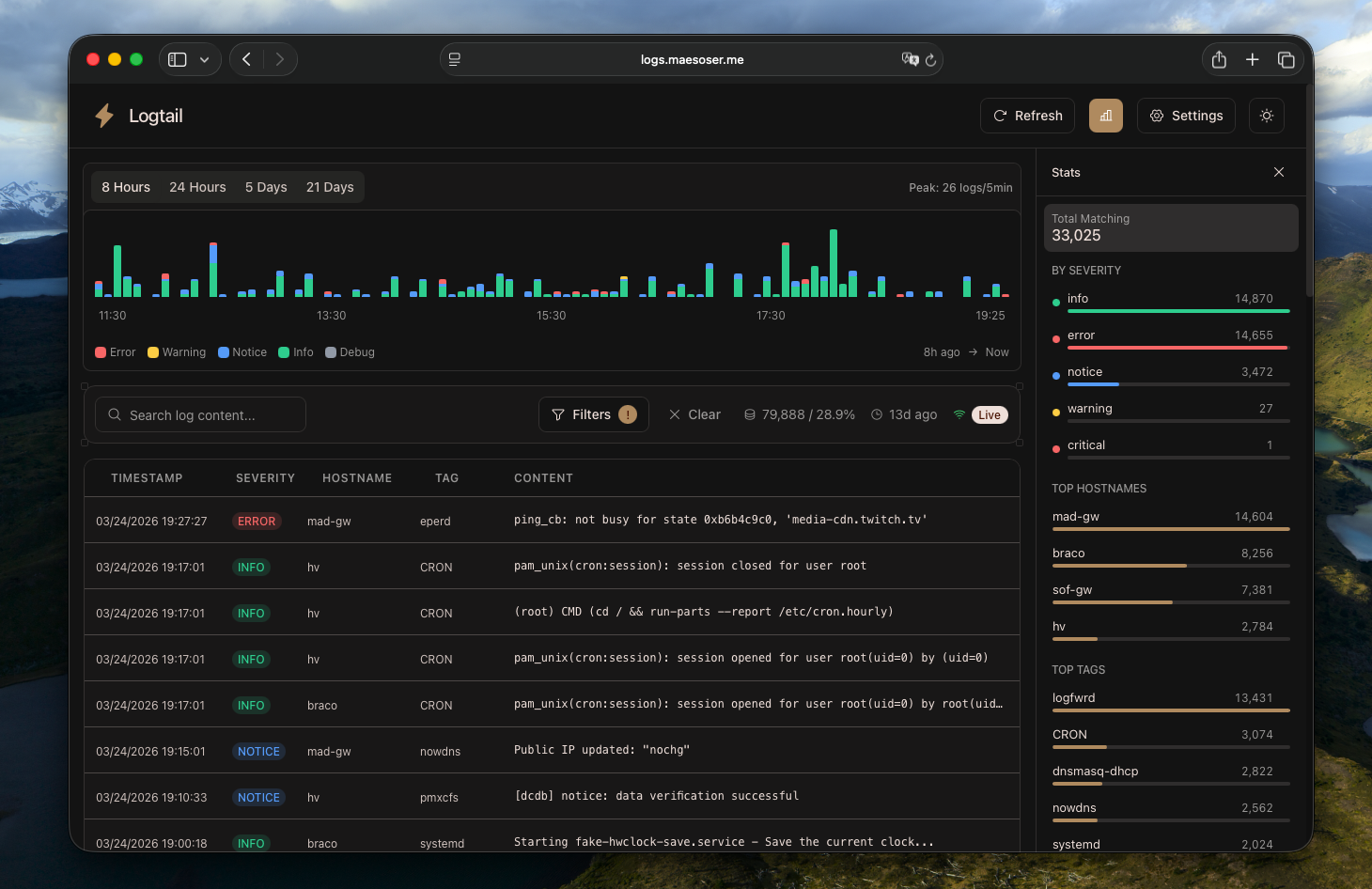
Now that the logs are in Logtail, let's talk about the philosophy behind it. In one word: simplicity. I don't need to worry about high-end scalability or data redundancy for a homelab, provided the tradeoffs favor ease of use. My goal was a tool that:
- Ships as a single binary with an embedded UI that can be easily cross-compiled
- Keeps writes minimal and storage simple: it uses a ring buffer in RAM and periodically persists state using Go's gob encoding
- Ingests logs from remote sites via the client-server architecture
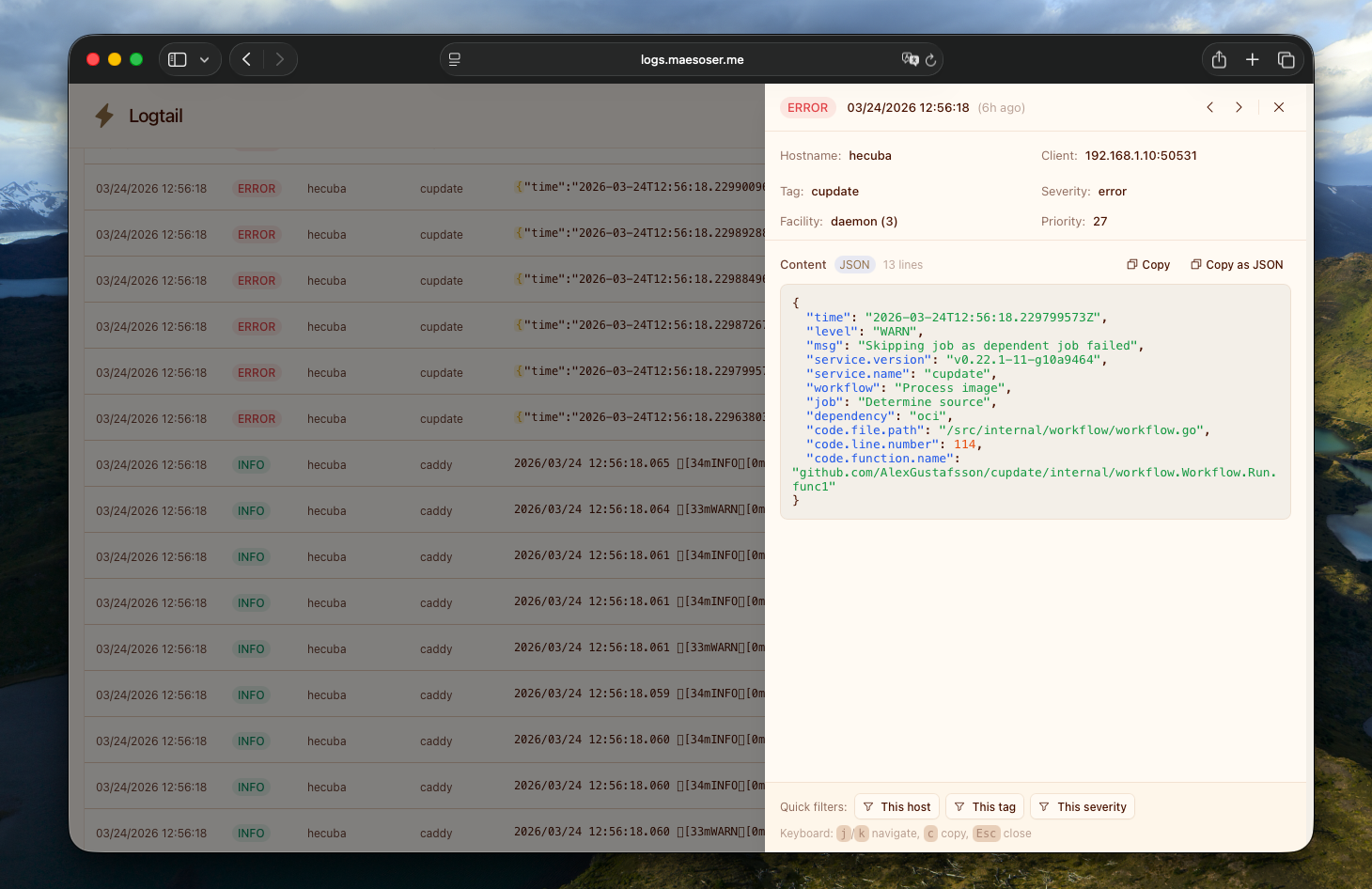
- Has basic analytics and filtering capabilities
A word on AI
I'm not a programmer. I'm definitely not a web programmer. And yet, I was able to build a useful, working tool in just a few weeks with the help of Claude.
The backend is Go, a language I have some exposure to. But the frontend? React, TypeScript, Tailwind, WebSockets... that's well outside my comfort zone. What would have taken me months of fighting with documentation and Stack Overflow threads got done in a fraction of the time, because I could describe what I wanted in plain language and iterate quickly on the result.
I'm not going to pretend AI wrote everything perfectly on the first try, or that I just sat back and watched it work. But it lowered the barrier enough that a hobbyist like me could ship something real. That's a big deal. We're in a genuinely exciting moment where the gap between "I have an idea" and "I have a working tool" has never been smaller.